Spider AF /
Resources /
Articles /
Ad stacking fraud: what it is, how to spot it, and how to stop paying for invisible impressions
No items found.
October 2, 2025

Ad stacking fraud: what it is, how to spot it, and how to stop paying for invisible impressions

In this article

01
What is a click farm?
01
What is a click farm?
01
What is a click farm?
01
What is a click farm?
01
What is a click farm?
Quick take · 30-second version

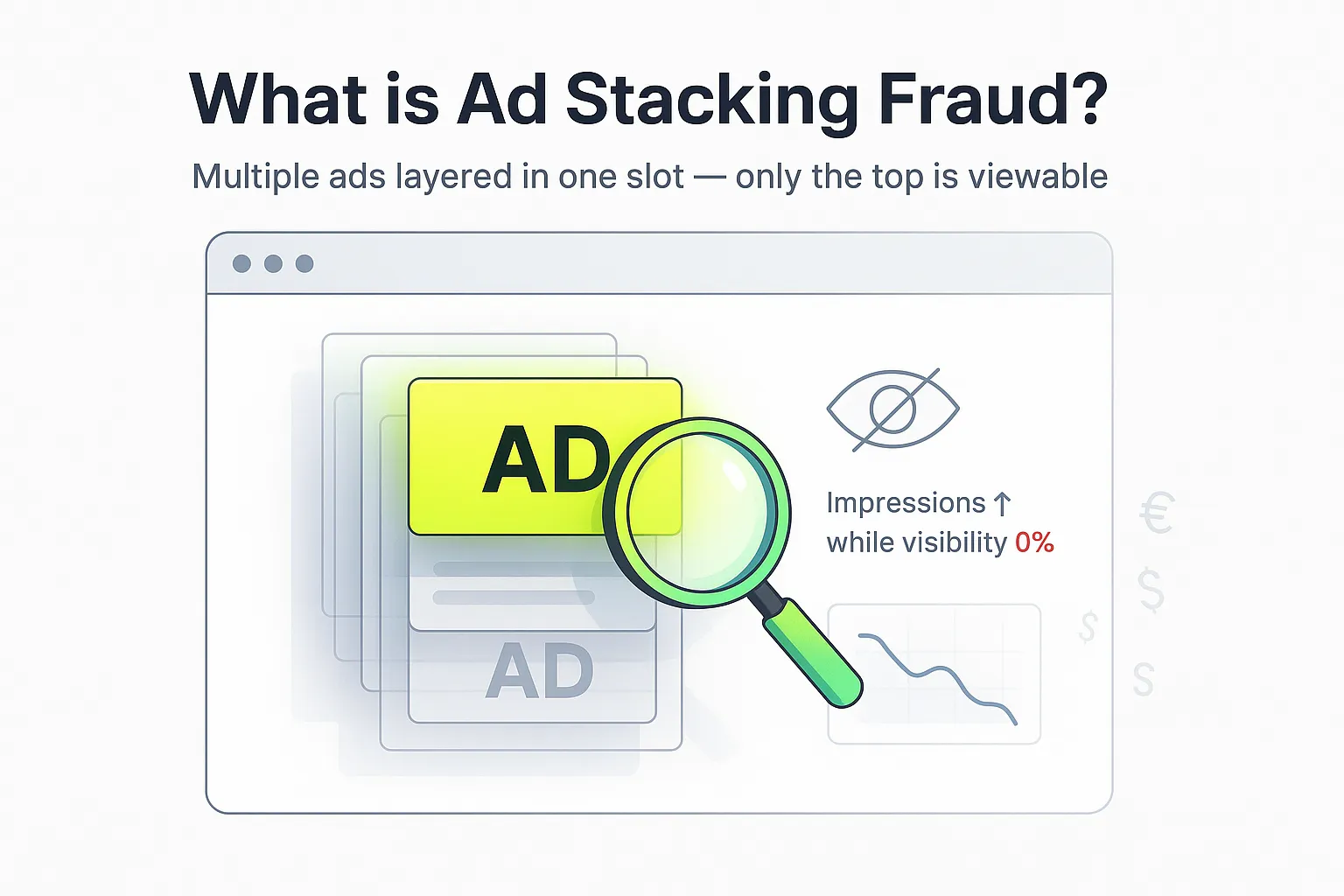
What is ad stacking fraud?

Ad stacking fraud happens when multiple ads are placed in a single ad slot, layered on top of one another so that only the top ad is viewable—but every ad in the stack still records an “impression.” You pay for visibility that never actually occurred. Industry bodies classify it under invalid traffic (IVT) / impression fraud and explicitly call out “stacked and hidden ads” as a common tactic.

Why it matters in 2025

On the open web and in apps, stacking skews reach and frequency, tanks viewability, and pollutes optimization signals—especially in auto-optimized buying where algorithms “learn” from poisoned data. Standards bodies (MRC/IAB) also flag “invisible ad delivery” as invalid placements your measurement should exclude, underscoring why advertisers must detect and filter it at source.

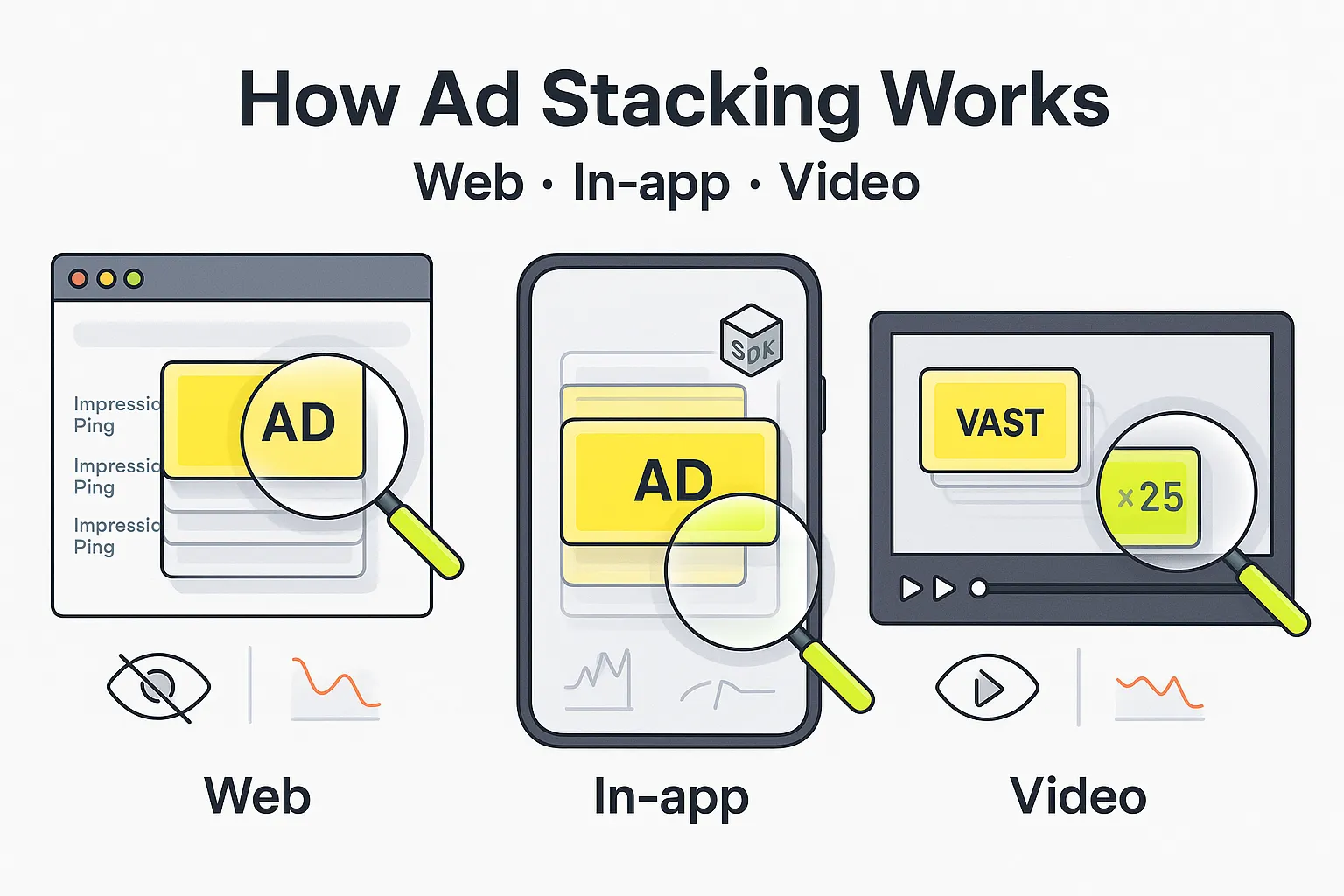
How ad stacking works (web, in-app, and video)

  • Web display: shady publishers overlay several banners in one placement; you see one, but multiple ad calls and impression pings fire.
  • In-app/mobile: SDK or JavaScript manipulations can layer creatives; some schemes render ads at 0% opacity or off-screen while registering viewable impressions.
  • Video (VAST): the Vastflux scheme stacked up to 25 video ads in a single slot on as many as 11 million devices, proving stacking can be industrialized at scale.

The business impact

  • Budget waste: you’re billed for impressions no one could see. (IAB Europe calls this out directly under “Ad Stacking.”)
  • Corrupted optimization: stacked impressions depress CTR/engagement and mislead bidding algorithms, creating a feedback loop of poor allocation. (MRC frames invisible placements as invalid, i.e., to be removed from counts.)
  • Measurement risk: inflated reach/frequency, inaccurate viewability, and phantom lift make creative and audience tests unreliable. (IAB Europe’s guide details how site/app/device fraud distorts reporting.)

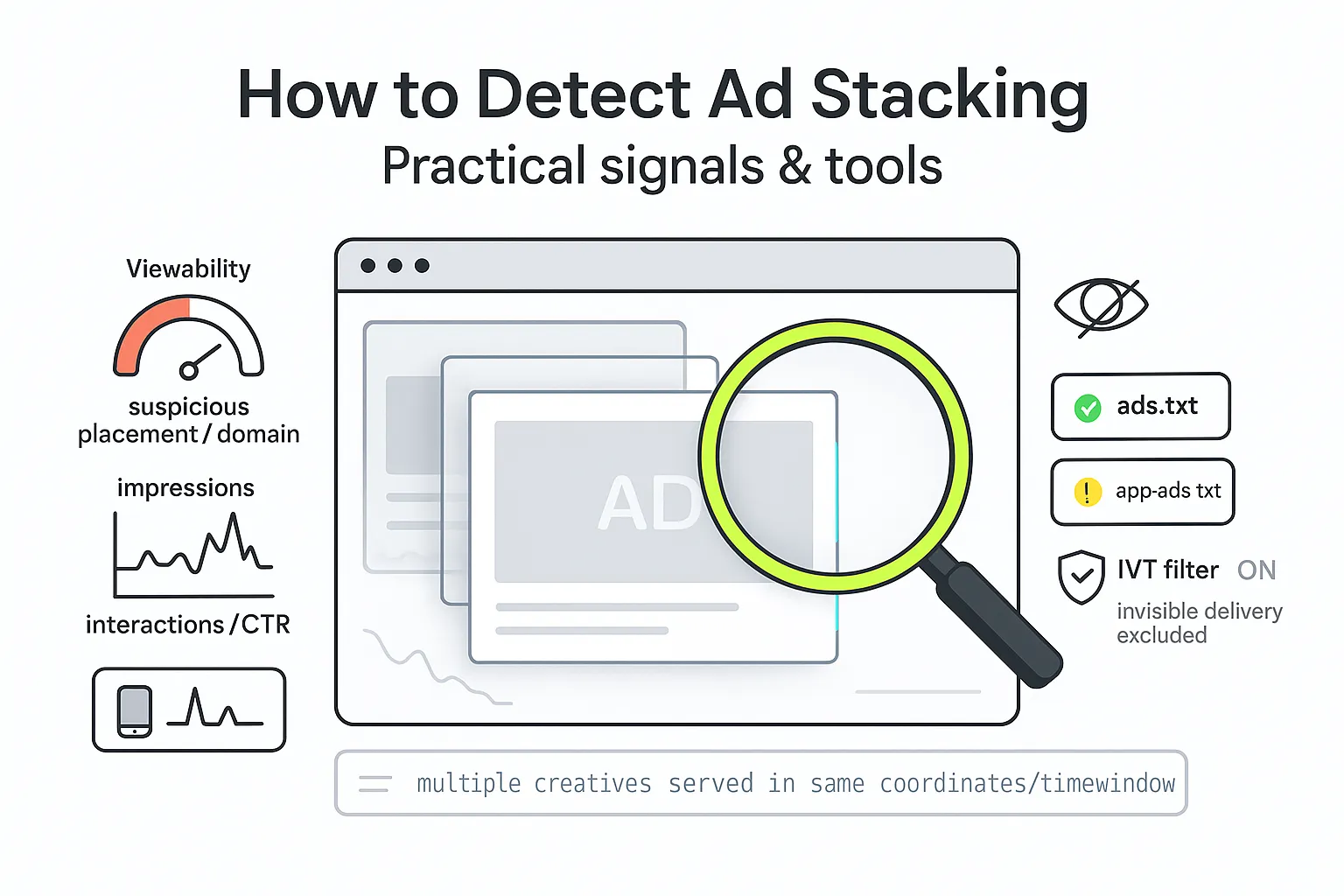
How to detect ad stacking (practical signals & tools)

Symptoms in your data

  • Abnormally low viewability from specific domains/placements relative to peers.
  • High impressions with near-zero interactions across identical audiences.
  • CPU/battery spikes in mobile app inventory (video stacking burns device resources; Vastflux exhibited this).

Verification & standards to lean on

  • Follow IVT standards: ensure your measurement/verification adheres to MRC IVT guidance, which requires filtration of invisible or tiny placements.
  • Harden the supply chain: implement/verify ads.txt/app-ads.txt to reduce spoofed or non-authorized sellers where stacking often hides.

What Spider AF adds on top

  • PPC Protection: blocks invalid clicks and poor placements automatically, pushing IP/audience/placement exclusions back to ad platforms (Google, Meta, etc.), and includes MFA/brand-safety placement controls.
  • Placement controls for Display & PMax: auto-detect and suppress non-brand-safe or low-quality sites (e.g., ad clutter/collision categories where stacking-like patterns surface).
  • Full transparency: invalid-click and campaign-level reports show where budget was being siphoned. (Agencies use this to prove savings.)

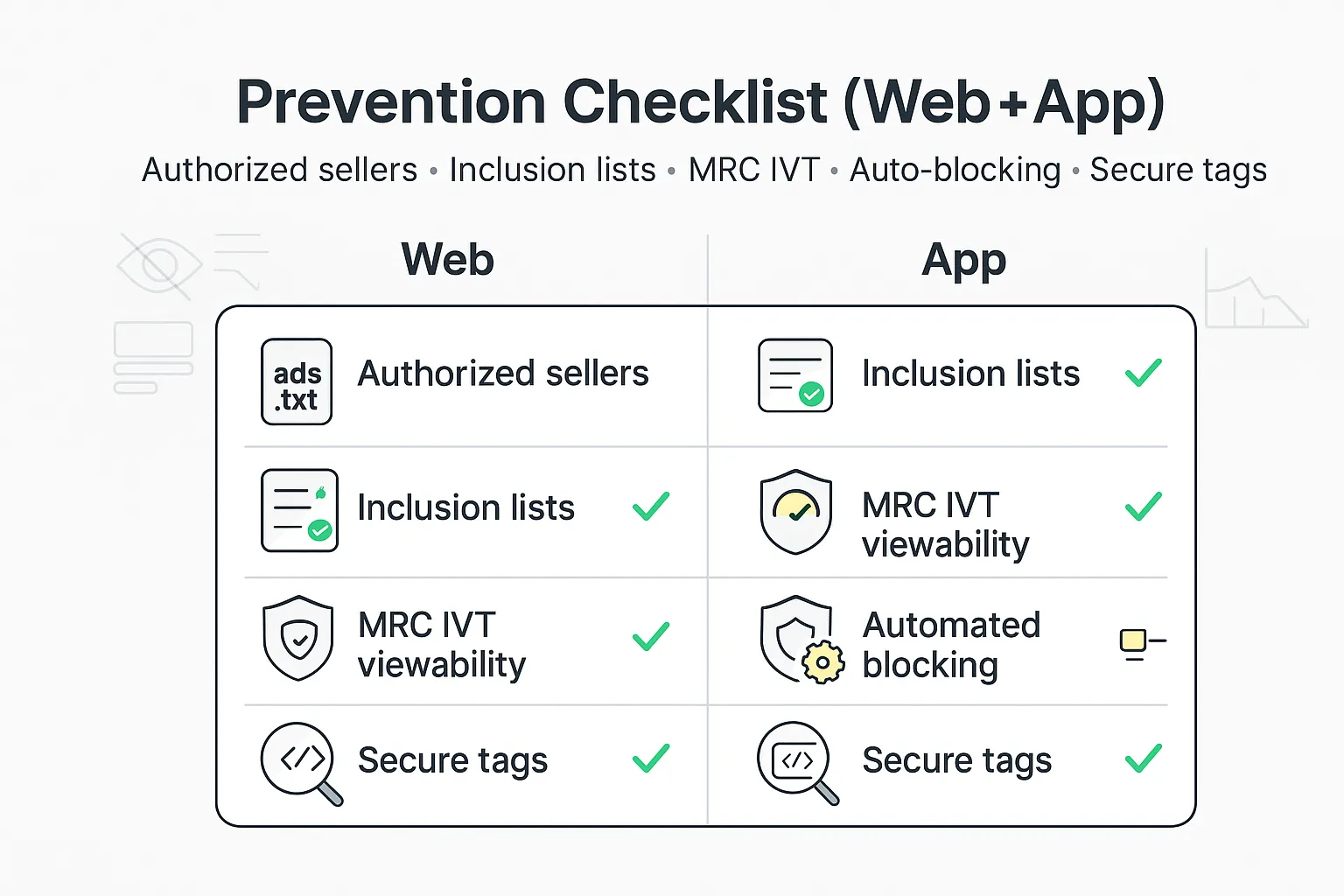
Prevention checklist (web + app)

  1. Enforce authorized sellers: keep ads.txt and app-ads.txt current; audit partners against your files.
  2. Use inclusion lists (sites/apps) and remove any placements with sustained low viewability or anomalous engagement.
  3. Instrument for visibility: require independent viewability/IVT reporting aligned to MRC guidance; exclude invisible/tiny ad sizes from “gross” counts.
  4. Automate blocking: deploy Spider AF PPC Protection to push hourly blocklists (IPs/audiences/placements) and auto-curate MFA/brand-safety categories.
  5. Secure your tags: stacking/hiding tricks often ride through unmanaged third-party scripts. Spider AF SiteScan continuously inventories and monitors client-side scripts, detects tampering/anomalies, and flags risky data exfiltration (PCI DSS v4.0.1 client-side controls are now explicit).

Common questions about ad stacking

Is ad stacking the same as pixel stuffing?

They’re cousins. Pixel stuffing crams ads into a 1×1 (or tiny) frame; ad stacking layers multiple full-sized ads in one slot. Both charge for unseen impressions. Industry guides list both tactics under impression fraud.

Do platforms already block this?

Major platforms filter some IVT, but sophisticated schemes still break through (e.g., mobile video stacking at scale). You need independent detection, supply-chain hardening, and automated enforcement.

What evidence proves stacking?

Look for: (1) extremely low Active View on specific placements; (2) impression logs showing multiple creatives “served” in the same coordinate/time window; (3) device telemetry stress for mobile video inventory consistent with multiple simultaneous decodes.

How Spider AF stops budget drain from stacked/hidden ads

  • Detect + block invalid clicks and poor placements; hourly audience/IP/placement exclusions keep campaigns clean without manual babysitting.
  • Placement hygiene for Display/PMax (brand-safety & MFA categories) to choke supply where stacking thrives.
  • Script monitoring (SiteScan) to catch malicious/altered tags that can enable hidden rendering behavior.
  • Proven savings: agencies and advertisers using Spider AF report substantial blocked fraud and recovered budget (e.g., thousands of fraudulent clicks blocked and five-figure spend saved).

Conclusion: make stacked ads a non-issue

Ad stacking siphons spend, skews optimization, and erodes trust. The fix is equal parts supply-chain hygiene, standards-aligned measurement, and automated enforcement.
If you want a fast, low-lift way to cut waste now:

You’ll get cleaner data, better ROAS, and immediate protection where stacking sneaks in.

FREE SCAN

See your account's invalid traffic in 24 hours.

Spider AF will quantify exactly how much of your last 30 days of paid spend went to bots and click farms.

No credit card
1-line install
Cancel any time
Or book a 20-min demo
FAQ

People also ask.

Q 01 Are click farms illegal? +
In most jurisdictions, click farms violate ad-network terms of service and consumer-protection laws — but enforcement is patchy and cross-border. The FTC has taken action against fake-engagement operations, and Japan's METI has issued guidance treating fake reviews and bot traffic as deceptive practices. The practical reality: legal action is slow; technical blocking is fast.
Q 02 How is a click farm different from a botnet? +
Click farms typically use real humans (or human-supervised devices) to evade behavioral detection — they pass CAPTCHAs, mimic mouse movement, even simulate purchase journeys. Botnets are fully automated and easier to fingerprint. Modern fraud usually blends both: bots for volume, human "supervisors" for the high-value clicks.
Q 03 Can Google Ads or Meta detect click farms on their own? +
Both networks credit obviously-invalid clicks, but their detection runs on aggregated, post-hoc statistical signals — they refund days or weeks later. By then, your bidding algorithms have already optimized toward the polluted data. Independent, real-time detection at the click layer is what closes the loop.
Q 04 Will blocking click-farm traffic hurt my reach? +
No. Blocking invalid clicks only removes traffic that was never going to convert. The downstream effect is usually the opposite — your bidding model gets cleaner training signal and starts spending more on audiences that actually convert.
Q 05 How fast can Spider AF block click-farm traffic? +
Sub-200ms detection at the click event, with auto-sync to Google, Meta, TikTok, and Microsoft exclusion lists in seconds. Most accounts see meaningful blocking within 24 hours of installing the tag.

Ad stacking fraud: what it is, how to spot it, and how to stop paying for invisible impressions

Table of Contents

What is ad stacking fraud?

Ad stacking fraud happens when multiple ads are placed in a single ad slot, layered on top of one another so that only the top ad is viewable—but every ad in the stack still records an “impression.” You pay for visibility that never actually occurred. Industry bodies classify it under invalid traffic (IVT) / impression fraud and explicitly call out “stacked and hidden ads” as a common tactic.

Why it matters in 2025

On the open web and in apps, stacking skews reach and frequency, tanks viewability, and pollutes optimization signals—especially in auto-optimized buying where algorithms “learn” from poisoned data. Standards bodies (MRC/IAB) also flag “invisible ad delivery” as invalid placements your measurement should exclude, underscoring why advertisers must detect and filter it at source.

How ad stacking works (web, in-app, and video)

  • Web display: shady publishers overlay several banners in one placement; you see one, but multiple ad calls and impression pings fire.
  • In-app/mobile: SDK or JavaScript manipulations can layer creatives; some schemes render ads at 0% opacity or off-screen while registering viewable impressions.
  • Video (VAST): the Vastflux scheme stacked up to 25 video ads in a single slot on as many as 11 million devices, proving stacking can be industrialized at scale.

The business impact

  • Budget waste: you’re billed for impressions no one could see. (IAB Europe calls this out directly under “Ad Stacking.”)
  • Corrupted optimization: stacked impressions depress CTR/engagement and mislead bidding algorithms, creating a feedback loop of poor allocation. (MRC frames invisible placements as invalid, i.e., to be removed from counts.)
  • Measurement risk: inflated reach/frequency, inaccurate viewability, and phantom lift make creative and audience tests unreliable. (IAB Europe’s guide details how site/app/device fraud distorts reporting.)

How to detect ad stacking (practical signals & tools)

Symptoms in your data

  • Abnormally low viewability from specific domains/placements relative to peers.
  • High impressions with near-zero interactions across identical audiences.
  • CPU/battery spikes in mobile app inventory (video stacking burns device resources; Vastflux exhibited this).

Verification & standards to lean on

  • Follow IVT standards: ensure your measurement/verification adheres to MRC IVT guidance, which requires filtration of invisible or tiny placements.
  • Harden the supply chain: implement/verify ads.txt/app-ads.txt to reduce spoofed or non-authorized sellers where stacking often hides.

What Spider AF adds on top

  • PPC Protection: blocks invalid clicks and poor placements automatically, pushing IP/audience/placement exclusions back to ad platforms (Google, Meta, etc.), and includes MFA/brand-safety placement controls.
  • Placement controls for Display & PMax: auto-detect and suppress non-brand-safe or low-quality sites (e.g., ad clutter/collision categories where stacking-like patterns surface).
  • Full transparency: invalid-click and campaign-level reports show where budget was being siphoned. (Agencies use this to prove savings.)

Prevention checklist (web + app)

  1. Enforce authorized sellers: keep ads.txt and app-ads.txt current; audit partners against your files.
  2. Use inclusion lists (sites/apps) and remove any placements with sustained low viewability or anomalous engagement.
  3. Instrument for visibility: require independent viewability/IVT reporting aligned to MRC guidance; exclude invisible/tiny ad sizes from “gross” counts.
  4. Automate blocking: deploy Spider AF PPC Protection to push hourly blocklists (IPs/audiences/placements) and auto-curate MFA/brand-safety categories.
  5. Secure your tags: stacking/hiding tricks often ride through unmanaged third-party scripts. Spider AF SiteScan continuously inventories and monitors client-side scripts, detects tampering/anomalies, and flags risky data exfiltration (PCI DSS v4.0.1 client-side controls are now explicit).

Common questions about ad stacking

Is ad stacking the same as pixel stuffing?

They’re cousins. Pixel stuffing crams ads into a 1×1 (or tiny) frame; ad stacking layers multiple full-sized ads in one slot. Both charge for unseen impressions. Industry guides list both tactics under impression fraud.

Do platforms already block this?

Major platforms filter some IVT, but sophisticated schemes still break through (e.g., mobile video stacking at scale). You need independent detection, supply-chain hardening, and automated enforcement.

What evidence proves stacking?

Look for: (1) extremely low Active View on specific placements; (2) impression logs showing multiple creatives “served” in the same coordinate/time window; (3) device telemetry stress for mobile video inventory consistent with multiple simultaneous decodes.

How Spider AF stops budget drain from stacked/hidden ads

  • Detect + block invalid clicks and poor placements; hourly audience/IP/placement exclusions keep campaigns clean without manual babysitting.
  • Placement hygiene for Display/PMax (brand-safety & MFA categories) to choke supply where stacking thrives.
  • Script monitoring (SiteScan) to catch malicious/altered tags that can enable hidden rendering behavior.
  • Proven savings: agencies and advertisers using Spider AF report substantial blocked fraud and recovered budget (e.g., thousands of fraudulent clicks blocked and five-figure spend saved).

Conclusion: make stacked ads a non-issue

Ad stacking siphons spend, skews optimization, and erodes trust. The fix is equal parts supply-chain hygiene, standards-aligned measurement, and automated enforcement.
If you want a fast, low-lift way to cut waste now:

You’ll get cleaner data, better ROAS, and immediate protection where stacking sneaks in.

SpiderAF
アドフラウド
Spider Labs