


%20ENJAL-banner(NEW).png)

Introduction
Mandai Design is a German company specializing in high-quality, modern retail furniture and shopfitting products. Its customer base is primarily B2B: shop owners and businesses looking for stylish, functional fixtures for retail spaces. The company serves markets across Germany, Europe, and the United States, with a small showroom presence in Singapore.
Paid advertising plays a central role in Mandai Design’s marketing strategy, with ongoing investments across Google, Meta, and Pinterest to generate qualified leads and inquiries. Since conversions primarily occur through contact forms and email inquiries rather than direct online sales, campaign performance depends heavily on reaching the right audience and driving high-quality traffic.
For Dirk, who manages the company's marketing directly, the previous eighteen months had shown a troubling pattern: budgets were rising, performance was declining, and more of the traffic looked suspicious.
Initial Engagement with Spider AF
Around 18 months before joining Spider AF, Mandai Design began noticing a disconnect between campaign spend and results. Performance Max campaigns across Google, Meta, and Pinterest were generating strong click volumes, but those clicks were not turning into real customer inquiries. Contact form submissions were coming in, but many were not genuine leads.
"We ended up with contact form submissions that were mostly from bots," Dirk recalls. "And we found out, this is not the solution."
What were the main challenges you faced before working with Spider AF?
"We were making substantial investments in paid advertising, but gradually we noticed rising costs without achieving the results we expected," Dirk explains. "Google kept recommending additional optimizations and increased activity. Our marketing agency shared a similar perspective, but they also couldn't offer a concrete solution that addressed the underlying issue."
Performance Max had seemed like a logical move for a visually driven product line. Instead, it brought a surge in non-human traffic that distorted campaign reporting and made meaningful optimization impossible. Mandai Design’s Google Ads account, built over years of campaign history, had accumulated so much bad conversion data from bot activity that its machine learning was effectively training on fraudulent signals.
"I would say the account was no longer properly structured or clean, and if your goal is to run conversion-optimized campaigns, that becomes a serious obstacle."
What were you using to identify wasted spend before Spider AF?
Before finding Spider AF, Dirk tried another tool from a small startup, but saw no meaningful results. "I tried and tested it, and I found out it was just a startup testing things on my shoulders."
His agency and Google reps consistently advised him to spend more rather than investigate traffic quality. The agency also warned him against trying Spider AF, suggesting he might "lose some customers."
How did you find Spider AF?
"I saw your system and checked it on your website. And I found, wow, they're really professional, because the chatbot was answering exactly what I was looking for." Despite initial hesitation about the price, Dirk was convinced by the quality and precision of the product. The support team followed up quickly, and the next steps were straightforward.
Experience with Spider AF
Once integrated through a tracking script on their Shopify store, Spider AF gave Dirk something he had not had before: daily, granular visibility into where his traffic was coming from and why so much of it was not converting.
How do you use Spider AF data in your day-to-day decisions?
"We can see every day what's going on and we can be a bit smarter," Dirk says. "We can say, okay, now this is not the right way. One day, we asked: why do we have a problem here? And then we found out: there is one country not included in our targeting."
The data confirmed what Dirk suspected. Much of the invalid traffic was coming from data centers and VPN-masked sources, both strong indicators of bot activity. This gave him the evidence he needed to act.
"Now I can say no, we are not on the right track. I can see the traffic."
The ongoing support from Spider AF's customer success team also stood out. Dirk described his CS contact as "really professional and good at explanation, not just 'it's like this, this, this.' She's very focused." He added, unprompted, that she deserves a pay raise.
The dashboard itself earned consistent praise for its clarity. "Your dashboard is fine. It's clear." Minor layout feedback was passed directly to the team through their regular monthly syncs.
Impact of Implementing Spider AF
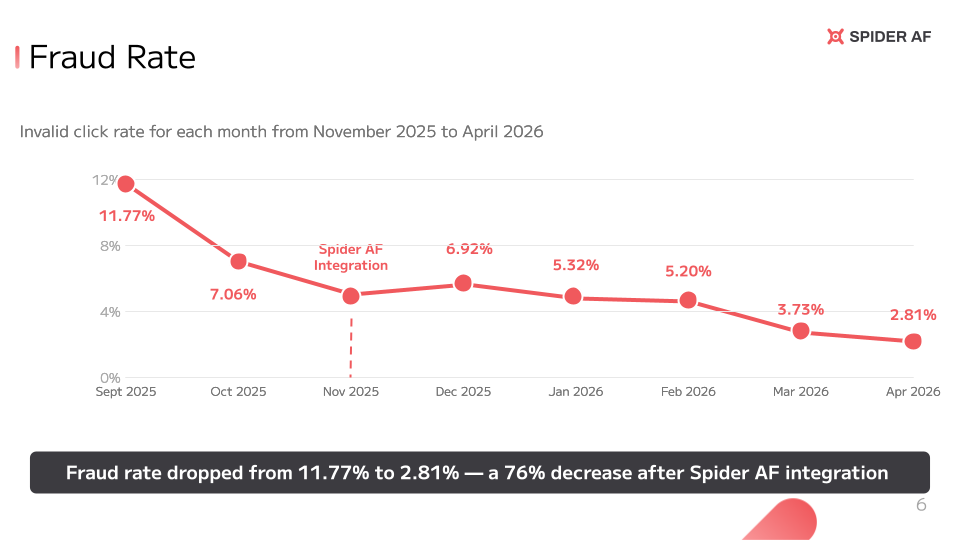
With Spider AF in place, Mandai Design's invalid traffic rate dropped from 11.77% in September 2025, the month they joined, to 2.81% by April 2026. That represents a 76% reduction. From November 2025 to April 2026, the tool blocked 22,223 fraudulent clicks, avoiding $7,038.09 in direct wasted ad spend.
But the bigger impact came from the decisions that Spider AF data made possible.
Which result has been most meaningful to your team?
"The control," Dirk says. "For a good company you need to have more control, and to get more control means you need some tools. And Spider AF is the correct tool."
With clear evidence that their Performance Max campaigns were generating large volumes of low-quality data center and bot traffic rather than genuine leads, Dirk decided to fundamentally rethink the company's digital marketing approach. He restructured the Google Ads strategy, substantially reduced reliance on external marketing services, and rebuilt both the German and English Google Ads accounts from the ground up to eliminate years of corrupted conversion data.“
How have the results affected your budget planning?
"Monthly saving is minimum €8,000." This figure accounts not only for avoided invalid clicks, but also for the Performance Max campaigns themselves (approximately €7,000+/month), agency fees, and the broader reallocation of budget toward higher-quality channels. "We should say we saved more than this, because we came to a decision: it makes no sense to do this anymore."
📊 Results Snapshot (November 2025 to April 2026):
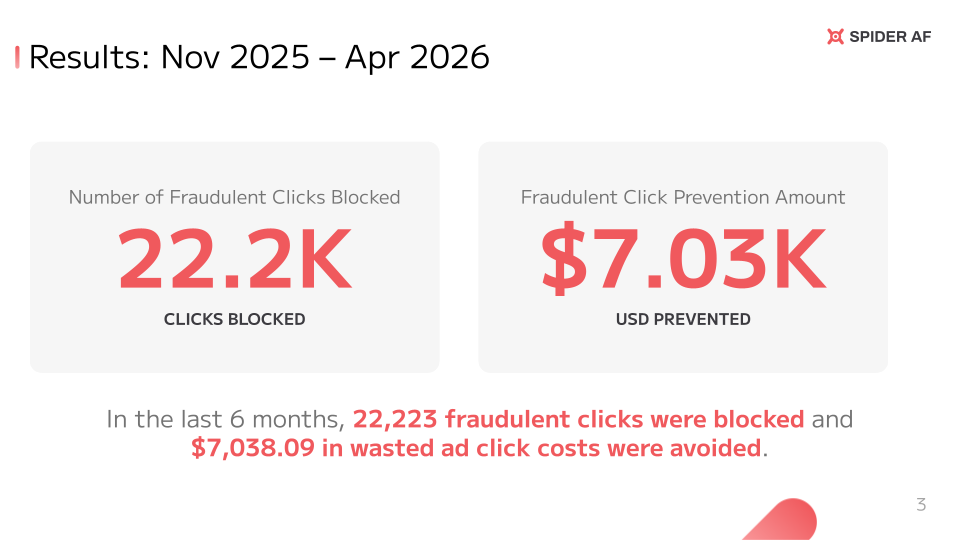
- 22,223 fraudulent clicks blocked
- $7,038.09 in direct wasted ad spend avoided
- Invalid traffic rate reduced from 11.77% to 2.81% (76% reduction)
- €8,000+ per month saved in campaign and agency costs
- Performance Max campaigns canceled entirely
- Google Ads accounts reset to restore clean conversion data
Moving forward, what improvements do you hope to see?
"We are preparing to launch new campaigns with professional content, a mixture of real videos and 3D video. And for this, I told all the team: let's save the cash, we need this for the new content, and then let's see what's going on."
Looking Ahead
With invalid traffic under control and campaign infrastructure rebuilt from the ground up, Mandai Design is moving into a new phase of growth with greater confidence in where its budget is going. For Dirk, the experience has changed how he thinks about marketing oversight and what it means to be in control.
Which part of Spider AF do you find most valuable?
"It's [a] really brilliant service, but also the people behind it are really important." For Dirk, the combination of a clear dashboard, transparent data, and a responsive support team has made the difference. "You need to show that you're not here just to implement and then disappear, you're here to make sure it's going well, for all the time."
What would you tell another advertiser considering ad fraud protection?
"You as an owner of a company need to have more control. It's not a solution to say, 'I have a good marketing agency that takes care of it for me.’ You need tools, and I think Spider AF is the correct tool."


%2520ENJAL-banner(NEW)%2520(2).png)
%2520ENJAL-banner(NEW).png)
%2520ENJAL-banner(NEW).png)